
Gas diluters and metrology
It’s evident that, due to the type of service (quality test on gas analyzers) gas dividers belong to the metrology world. It’s also evident that gas dividers outlet is not a measurement : they go through two flow measuring, but at the end the output value, the dilution ratio, is just a number : the ratio between two flows.
It exists at least another “tool” with the same type of performances : the piece counting scale. In this case two weigth measurements are done (the reference with one or few peaces and the counting hopper with the peaces to be counted). It translates the weigths ratio in the pieces number ratio and then the count.
Two so special devices should receive a special threatment : in the counting tool, everybody expects that the reference for counting is one or some peaces of the same family of that to be counted (internal reference violating traceability rule).
But now let’s come back to our diluters : we did setup a procedure that get advantage from the particolar structure of gas dividers series BetaCAP60 to give them a self test function.
Self referring test with BetaCAP60
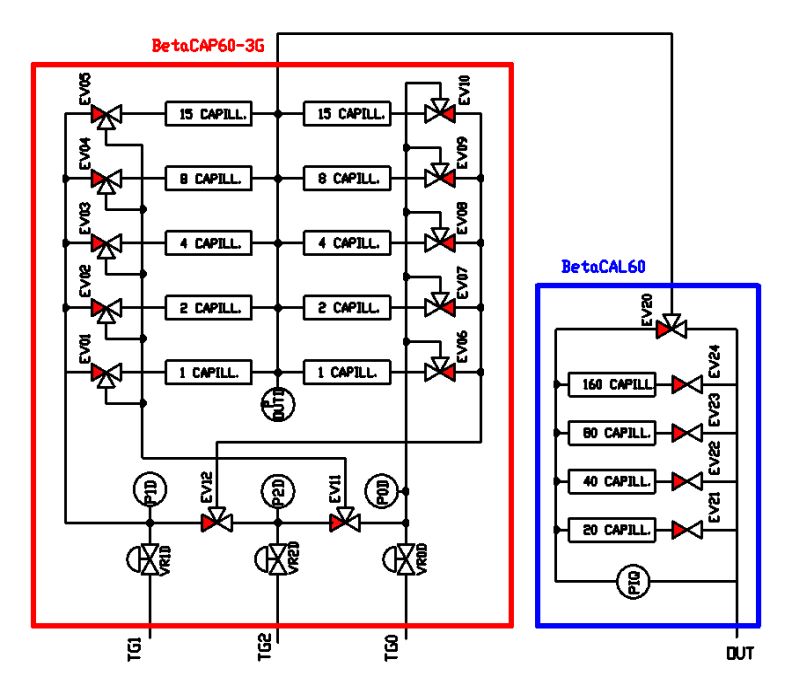
The construction of BetaCAP60 with two equal capillaries benches, each composed by 5 groups of capillaries with equal composition two by two. Two groups have 1 capillary each, two have 2 capillaries each two have 4, two have 8 and two have 15 capillaries each
As told in the introduction, the dilution ratio quality must be assured, but the flows used to calculate it just require to be each other in a given proportion : multiplying all of them by the same coefficient the result don’t change in terms of dilution ratio.
In this contitions, one capillaries group can be assumed as reference to which all the other capillaries must be realated with flow proportionned to relevant capillaries number in the group. As the reference capillary we did select the one with single capillary placed in the left side module : the flow value that will cross it will be the single capillary flow reference.
Test is made by 5 phases : each phase will handle groups containing the same capillaries number with applied the same pressure, that induces very similar (theoretically equal) flows. The first phase is handling 1 capillary groups, the second 2 capillaries groups, the third 4, the fourth 8 and the fifth 15.
The above flows must be compared : to do that in the diluter it’s istalled an optional “not traceable meter” made by a selectable series of capillaries (to produce a differential pressure when crossed by the flow) and a differential pressure sensor indicating the flow. Capillaries selection in the meter is assigning the range : each phase (handling a different number of capillaries), send to the meter a different flow. Higher flows are measured as differential pressure across the higher number of flow meter capillaries : this way the sensor is subject to similar pressures in all the phases with different flows. Those pressure values are near to the sensor range (the area of better resolution). Scope of this test is to measure/calculate the deviations to the rule that the flows (applying the same pressure) resulting from each capillaries group are proportional to the number of capillaries included in that group.
In fact this is the consequence of the supposed capillaries equality : if they are equal, dilution is perfect, if not, the deviations can be used to calculate (and correct) the dilution deviation. The equality of the capillaries used in the flow meter is not critical : different capillaries in the flow meter are used in different phases and flow measurements made in different phases are not compared anymore.

The flows through the 5 capillaries groups in left side of the diluter are named a1, a2, a4, a8, a15 and the flows through the right side capillaries groups are named b1, b2, b4, b8, b15. Flows are also measured on the parallel of two groups with equal capillaries number (one in left side and another in right side) : those flows are named a1b1, a2b2, a4b4, a8b8, a15b15.
Than, let’s statr with
Phase 1
Sensitivities of the different measuring ranges used in each phase are not metrologically related each other, but are in reverse proportion with the flow to be measured : this assure a constant high resolution.

Step 1 : measuringa1

Step 2 : measuring b1

Activating the flow a1 it’s measured : the value a1 as already assumed, is our reference. We can then confirm that the relative deviation of the flow a1 is εr (a1)=0
Activating the flow b1 it’s measured the flow b1 and solved the formula a1+a1*εr(a1)=b1+b1*εr(b1).
εr(b1) = (a1-b1)/b1. Then we know the relative deviation of the single capillaries in left side and right side groups
For next use, we calculate R1= a1/b1
Phase 2
Activating the flows a1 and b1, in parallel, it’s measured the sum of the flows a1b1 = a1+b1
Activating the flow a2, it’s measured the value a2
Activating the flow b2, it’s measured the value b2

Step 1 : Activating the parallel of a1 and b1 is measured a1b1

Step 2 : is measured a2

Step3 : is measured b2

We then write two equations:
a1b1-εr(a1)*a1′)-εr(b1)*(b1′)=a2-εr(a2)*a2
a1b1-εr(a1)*(a1′)-εr(b1)*(b1′)=b2-εr(b2)*b2
But that’s not correct ! we know that flow measurements cannot be mixed in the same equation if not measured in the same phase (a1’ and b1’are measured in phase 1 and a2, b2, are measured in Phase 2..
Hopefully we have two important information : R1=a1/b1 that, as a flows ratio can be used wherever in different phases and a1b1 = a1+b1 is measured in phase 2 and then directly available in phase 2.equations
Joining in a system the two equations, R1 = a1/b1 and a1b1 = a1+b1 we get a1’=R1*a1b1/(1+R1) and b1’=a1b1/(1+R1)
We can then calculate εr(a2) and εr(b2), the relative deviations of groups with 2 capillaries left side and right side using the : a1b1-εr(a1)*R1*a1b1/(1+R1))-εr(b1)*a1b1/(1+R1)=a2-εr(a2)*a2
a1b1-εr(a1)*R1*a1b1/(1+R1)-εr(b1)*a1b1/(1+R1)=b2-εr(b2)*b2
For next use, we calculate R2=a2/b2
Phase 3
very similar to phase 2 (the range 4 is activated)
Activating the flow a4, it’s measured the value a4
Activating the flow b4, it’s measured the value b4
Activating the flows a2 and b2, it’s measured the value sum of the flows a2b2


t’s enough to change the indexes of the previous equation from 1 to 2 and from 2 to 4 to calculate εr(a4) e εr(b4)
Phase 4
Once activated, the a8 flow is measured a8
Once activated, the flow b8 is measured b8
Once the a4 and b4 flows are activated, the sum flow a4b4 is measured

I


t’s equal to phase 3 : it’s enough to change the indexes from 2 to 4 and from 4 to 8 to calculate εr(a8) e εr(b8)
Phase 5
It seems arriving a further difficulty, but it’s not : the comparison is not between groups with the same total capillaries number, but two groups have 8 capillaries and the bigger group have 15.

It’s enough to include in the equations a corrective factor 15/16
[a8b8-εr(a8)(a8′)-εr(b8)(b8′)] * 15/16 =a15- εr(a15)*a15 [a8b8-εr(a8)(a8′)-εr(b8)*(b8′)] * 15/16 =b15- εr(b15)*b15


Then we got the relative deviation of each capillaries group in the diluter εr(a1), εr(b1), , εr(a2), εr(b2), εr(a4), εr(b4), εr(a8), εr(b8),, εr(a15), εr(b15) and we can correct the theoretical flows to real measured flows, and finally the real dilution ratio and the deviation from the dilution target. Believing that data it’s possible to correct the target (deducting the deviation) to get the right dilution.
Final considerations
Repeating different runs of the complete procedure is prossible to observe very low variance not specially on the measured flow values, but mainly on the calculated relative deviations : this is a confirmation of reliability. Another important point is the constant high resolution of measured flows and calculated relative deviations, not depending on flow size.
Beyond these observations, it’s normal the fact that who spent his life promoting without conditions the traceability principle, can be sceptical about this procedure where nothing is traceable. That’s normal.
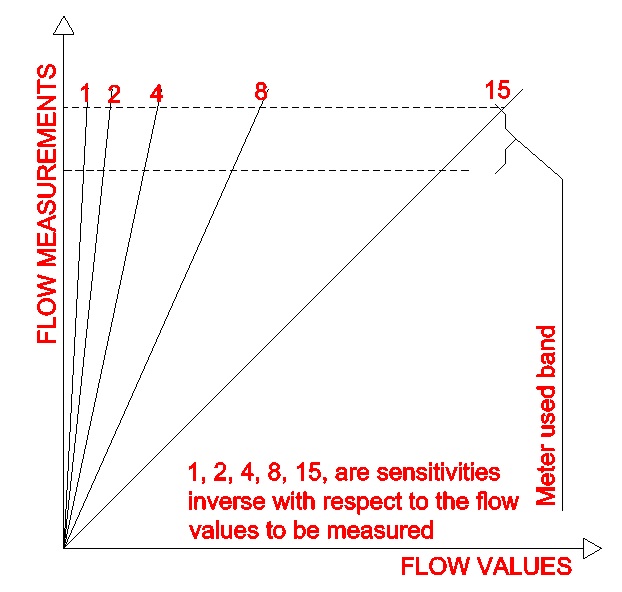
Two word more about the flow meter : the ranges selection is managed (automatically) in a way that lower sensitivities are applied when high flows (through many diluter capillaries) are to be measured and vice versa for higher sensitivities. That way the measured differential pressure is always in a narrow band of the DP meter and this used band is near the upper range, where measuring resolution is maximum. That’s the reason of the high accurate results.
The importance of measuring flows ranges and measuring resolution is evident comparing this methode with traceable methods : each type of diluter (using fixed components to control the flows or using flow controllers to be linearised) need for his setup to measure accurately the flows in many points of the range : in this task, measurements with lower values can be evaluated with lower resolution, than lower quality., compared to end of instrument range. This is more important, with higher dilution dividers.